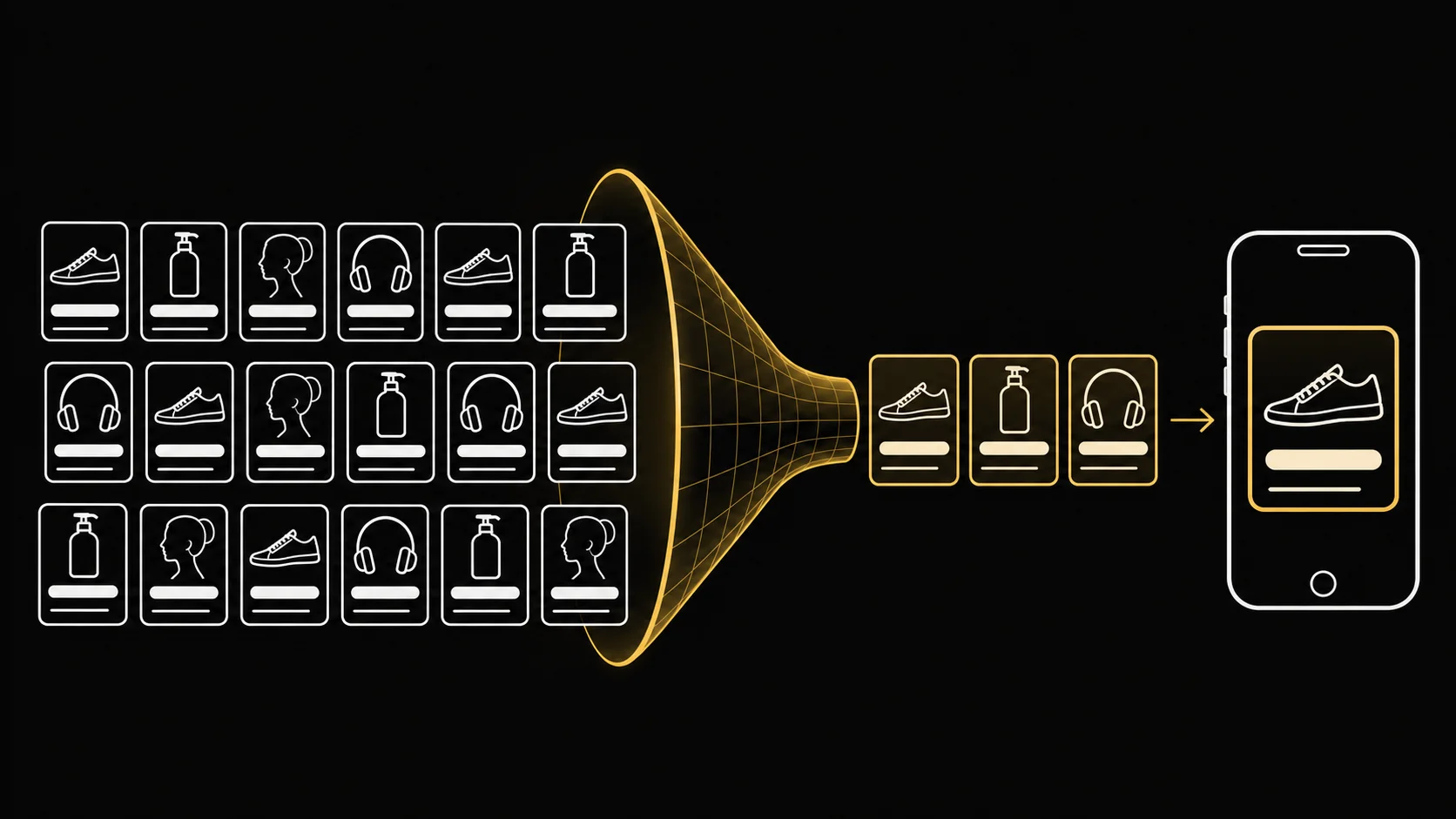
Your Meta results moved last week, and the explanation that came back was “Meta Andromeda”. The advice going around ranges from launching 50 new ads per ad set, to rebuilding the account, to ignoring it, and the wrong choice costs a creative budget or a quarter of testing. This guide sorts what Meta has said about Andromeda from the claims that are not in its pages, so you know what to change in your next creative plan.
Andromeda is the part of Meta’s ad system that decides which few thousand ads, out of tens of millions, are even considered for each person.
The short version: You do not need to rebuild your account for Meta Andromeda. Meta says its October 2026 update to Andromeda, the engine that shortlists ads before ranking, arrives automatically with no setting to switch on. Its advice is to supply more creative variety. None of the Meta pages we read sets a number of ads per ad set.
What is Meta Andromeda?
Meta Andromeda is the engine that runs retrieval, the first step of Meta’s ad delivery. Meta introduced it in 2024 and describes that stage as “tasked with selecting ads from tens of millions of ad candidates into a few thousand relevant ad candidates” in its December 2024 engineering post.
Retrieval comes before ranking and the auction, as Meta’s October 2026 post on ad delivery lays out. A December 2025 Meta post says Andromeda selects candidates “so only the most relevant and distinct creatives move forward”.
What did Meta announce in October 2026?
On October 28, 2026, Meta published an engineering post on the next version of Andromeda and two advertiser posts. The new version scores every eligible ad and processes 100x as many ads per second as the 2024 system. Meta says the gains reach accounts automatically.
The engineering post puts the speed at “over one billion ads per second”. One of the advertiser posts adds what it means for your business: “more of your ads, creative variations and products are considered for each person”.
The same post reports “a 2.4% increase in conversions on Facebook” since 2025. That is a platform-level figure, not a forecast for your account.
What has Meta said, and what has it not said?
Meta has described what Andromeda does, published speed and conversion figures, and repeatedly told advertisers to supply more creative variety. The Meta pages linked in this article, read on November 14, 2026, contain no similarity percentage that stops delivery, no required number of ads per ad set, no rollout end date, and no statement that targeting ended.
| Claim | Where it comes from | In the Meta pages we read? |
|---|---|---|
| Retrieval narrows tens of millions of ads to a few thousand | Engineering at Meta, Dec 2024 | Yes |
| The 2026 system scores every eligible ad and handles 100x as many ads per second | Engineering at Meta, Oct 2026 | Yes |
| A 2.4% increase in conversions on Facebook since 2025 | Engineering at Meta, Oct 2026 | Yes |
| The gains arrive with no setting to switch on | Meta for Business, Oct 2026 | Yes |
| Ads that look or feel alike are variations of one creative | Meta for Business, Dec 2025 | Yes |
| Adopt Advantage+ and supply more creative variety | Meta for Business, Oct 2026 | Yes |
| Keep at least 20 diversified ads in Advantage+ shopping campaigns | Meta for Business, Nov 2024 | Yes, in 2024, for one campaign type |
| A similarity percentage that stops delivery | Third-party explainers | No |
| A required number of ads per ad set | Third-party explainers | No |
| A date the rollout finished | Third-party explainers | No |
| Andromeda ended interest and audience targeting | Third-party explainers | No |
Three caveats. Meta’s Help Center does describe a creative diversity score labeled High, Medium or Low, with no threshold values given. Four pages we cite (the 2024 best-practice post, the creative differentiation guidance and two Help Center articles) never mention Andromeda, so connecting them to it is our reading. We did not review Meta’s earnings calls.
Does Andromeda change how you should plan creative?
Yes. Meta’s advice is to plan for variety, and it has linked creative diversification to Andromeda since March 2025. Its October 2026 tips say to “supply more creative variety so the system has more to test and learn from”. The reason, by Meta’s own description: ads that look or feel alike count as variations of the same creative.
The December 2025 post spells that out. Meta says its system “analyzes creatives and groups together ads that share key visual and thematic attributes”, and the goal it describes is ads that are “truly distinct in their visuals, messaging, and formats”.
Its creative differentiation guidance names the cost of falling short: “When creative is too similar, our system may not recognize it as different and could deliver it to the same sets of audiences.”
Here is how we apply that: count by concept first, meaning who the ad speaks to, what it promises and how it looks. Five ads with the same visual and a swapped CTA are one concept. Then vary hooks and formats inside the concepts that work, the order our creative testing framework follows.
Does it change targeting or account setup?
It does not have to. Meta’s October 2026 advertiser post says: “There’s no setting to switch on, no new campaign type to adopt, no migration to plan.” Your targeting still applies too. The October 2026 engineering post describes a retrieval step “enforcing advertisers’ targeting rules”. Where Meta does push is in its advice.
In its April 2025 post on diversification, Meta wrote that the focus “has shifted from niche targeting to creative diversification”. Its October 2026 tips go further and say to adopt Advantage+ as a whole, not one component at a time. Our reading: Meta is steering advertisers toward automation without requiring it.
How much to hand over is a separate decision, covered in our Advantage+ vs manual campaigns guide.
How can you tell whether Andromeda is why results changed?
Not directly. None of the Meta pages we read describes a report for the retrieval step. What Meta does document are its flags for creative that is worn out or too similar: the Creative limited and Creative fatigue statuses in the Delivery column, and a creative diversity score. Check those, then the causes you can inspect.
The Help Center article on creative fatigue says the statuses appear when an audience has seen the same ad too many times and cost per result rises. The creative diversity score compares the images and video thumbnails in an ad set, and Meta calls it “estimated and in development”. A Low label says your creative needs more variety. Neither flag shows what retrieval did.
If they are clean, rule out the ordinary causes:
- Tracking: the pixel or Conversions API feed, and attribution changes.
- Offer or landing page: price changes, checkout bugs, form friction.
- Creative age: how long the top ads have run, and their frequency.
- Budget: large daily changes or sudden cuts.
Our guide to spotting creative fatigue covers the signals that turn before ROAS does.
What should you change in your next creative plan?
Count your live ads by concept, write each new brief around one concept, keep small edits for refining winners, log every test, and set a refresh rhythm your budget can fund. The first step shows how much the rest has to change.
- Audit by concept. Group your live ads and count the concepts. If 12 ads collapse into 2 concepts, you have 2.
- Brief by concept: who the ad is for, what it promises, then the format.
- Keep small edits for proven concepts. A new headline on a winner is still the same concept.
- Log every test, so nobody reruns one you already paid for.
- Set a refresh rhythm: as many distinct concepts as your budget can test each month.
How many ads is that? The only number we found is in a November 2024 best-practice post: “at least 20 diversified ads in Advantage+ shopping campaigns” (now called Advantage+ sales campaigns). By December 2025, Meta was suggesting “building a broad portfolio of assets” in place of a fixed volume.
So, back to the three options, as we see them. Rebuilding the account for Andromeda’s sake is off the list: Meta says there is no migration to plan. Launching 50 ads helps only if they are different ideas. Ignoring Andromeda means ignoring Meta’s request for more variety, and creative is the biggest lever on Meta either way. Start this week by counting the concepts in your live ads.
Where does The Remarkable fit?
After the count come two questions: who makes the new concepts, and where do the ideas come from? Making them is our work as an AI creative agency. Creative strategists choose each angle, our own AI software builds the ad, and a human editor finishes it, in days. We make the ads and you run them, unless you also hire us as your paid media agency.
On a recent client TikTok campaign, cost per customer fell about 50% compared with the same campaign’s earlier creator-made ads, and production was about 10x faster. That result is from TikTok, and we do not offer it as a forecast for Meta.
For the ideas, start with what your competitors already repeat: the open angles are the ones they leave out. That is the job of the Free Creative Competitor Analysis. You name up to 3 competitors. Before a free 30-minute working session, we map the hooks, formats and claims in their active ads and come back with 3 tests for your next sprint.