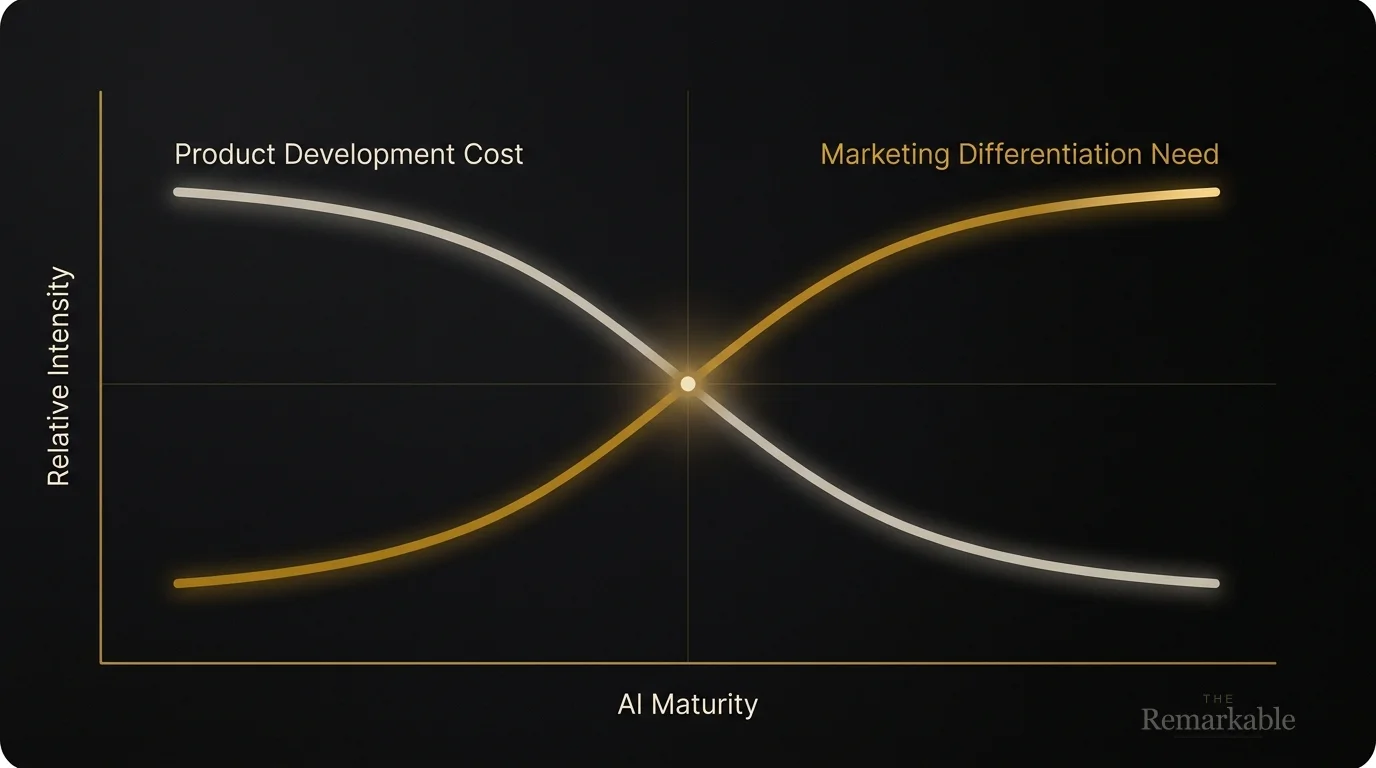
AI can reduce the time and cost of building a product. It doesn’t automatically bring customers to that product, and competitors can use the same tools to launch their own alternatives.
Plan how to reach customers while you’re building. Buyers still need to understand what the product does, why it matters to them, and where to find it.
The short version: Invest in a clear message and ways to reach buyers alongside product development. Paid media and outbound can support near-term demand while search, content, and relationships develop over time. This essay explains how I think about that balance and the marketing skills worth keeping on the team.
What’s Actually Changing in the AI Era?
The cost curve for building is collapsing while the cost curve for being heard is rising sharply. AI is compressing weeks of engineering into hours and weeks of content production into minutes, so more products reach the market than ever before. But human attention is finite, and it was already fragmented before this wave hit.
According to research from GitHub, developers using AI coding assistants complete tasks up to 55% faster than those working without them. That number has almost certainly grown since. Meanwhile, the number of software products launched per year keeps climbing, which means every category is getting more crowded at the same time every competitor is getting faster.
Here is the shift in plain terms:
| What Used to Be Hard | What's Hard Now |
|---|---|
| Building the product | Getting anyone to notice the product |
| Hiring a full engineering team | Hiring a marketer who can actually differentiate |
| Finding a defensible technical wedge | Finding a defensible position in the buyer's memory |
| Raising enough to finish v1 | Earning enough attention for v1 to matter |
None of the left column is easy. But the relative difficulty has flipped.
Why Does Cheap Building Make Marketing Harder?
Because when everyone can build fast, speed compounds for the companies that can also communicate clearly. The bottleneck moves from “can we make it?” to “can we break through the noise?” That second question is a marketing problem, not a product problem, and most founders are not prepared for it.
The economist Herbert Simon called this out in 1971, long before anyone was talking about AI. Simon observed that “a wealth of information creates a poverty of attention.” When information is abundant, the scarce resource is the ability of a human to care about any particular piece of it.
That math has gotten worse every year for fifty years. AI just kicked it into overdrive.
The practical consequence: two companies with near-identical products will have wildly different outcomes based on who tells the clearer story. The better feature set doesn’t decide it. What decides it is which company a buyer thinks of first when a problem surfaces in their week.
How Should Founders Prepare for This Shift?
Three moves matter most, and the window on all three is closing faster than most founders think.
1. Hold onto your marketers.
The resourceful marketer who can explain why your company matters is about to become your competitive advantage. I mean the generalist who can write, brief a designer, read a dashboard, run a campaign, and explain in one sentence why a customer should care. That person is rare, underpaid, and usually the first cut when a company tightens its budget.
Stop doing that. In a world where any competitor can ship a lookalike product in a weekend, the person who can make your company legible to a buyer is more valuable than another engineer.
2. Build your distribution channels today.
With the right people in place, give them time to build reach. Established companies have bigger email lists, older SEO programs, and sales teams with years of relationships. You cannot buy your way past that overnight. Start building your organic channels now, before you need them.
Organic content, SEO, AEO, PR, community, and thought leadership all compound. That compounding takes 12 to 18 months to show up in the numbers. If you wait until your runway is short to start, the flywheel will not spin up in time to save you.
3. Mix fast channels with long-term ones.
While those channels grow, paid media and outbound can deliver results you can measure this week. Organic content, SEO, AEO, and brand investment build over quarters and years, making monthly progress harder to measure. Most founders pick one approach and ignore the other. You need both.
| Channel Type | Time to Measurable Impact | What It Buys You |
|---|---|---|
| Paid media (Meta, Google, LinkedIn) | Days to weeks | Immediate pipeline and testing velocity |
| Outbound and partnerships | Weeks to months | Targeted reach into specific accounts |
| SEO and AEO | 6 to 18 months | Compounding discovery when buyers actively search |
| Organic content and PR | 12 to 24 months | Brand memory, the reason people call you first |
| Thought leadership | 18 months+ | Category authority and defensible positioning |
Running only fast channels makes you forgettable the minute you pause spend. Running only slow channels makes you invisible this quarter. The right portfolio runs both, with paid buying you time while organic compounds in the background.
What Does “Clarity Wins” Actually Mean?
Clarity means saying one true, specific, memorable thing when every product in a category sounds the same. It takes more than a tagline. Choose what to leave out so buyers remember the point that matters across those channels.
Most founders I talk to can list ten things their product does. Almost none of them can tell me, in one sentence, the specific customer problem they solve better than anyone else. That second sentence is the entire marketing asset. Everything else is noise.
Brand and positioning used to feel like luxuries, the kind of work you did after product-market fit. In the AI era, they are becoming the moat. They are what is left standing when the technical wedge erodes and ten competitors ship the same features next quarter.
The Companies That Survive Will Be the Ones People Remember
The companies that make it through this shift won’t be the ones with the most features or the slickest AI stack. That stuff is fast becoming table stakes. Everyone will have it.
The ones who make it are the ones people actually think of when it’s time to buy.
That means investing in what AI cannot scale for you: trust, clarity, brand memory, real customer relationships, and a point of view people associate with your name. These take deliberate work over more than a quarter. They cost money, too.
For an AI company, the next decision is where to earn attention now and what to build over time. Our AI Performance Creative work helps turn positioning into ads you can test with potential buyers.
A free strategy call can help you choose that first move. We’ll discuss who needs the product, how they currently find you, and which message or channel deserves a test.
Up next: The Playbook. This essay frames the strategic problem. For the operating answer, see The AI Performance Creative Playbook, which covers what to do about it: workflow, economics, the 2026 tool stack, and the first 30 days of standing this up.
A shorter version of this essay first appeared on LinkedIn.
Like this? Get the next one.
Short emails. New posts as they ship.