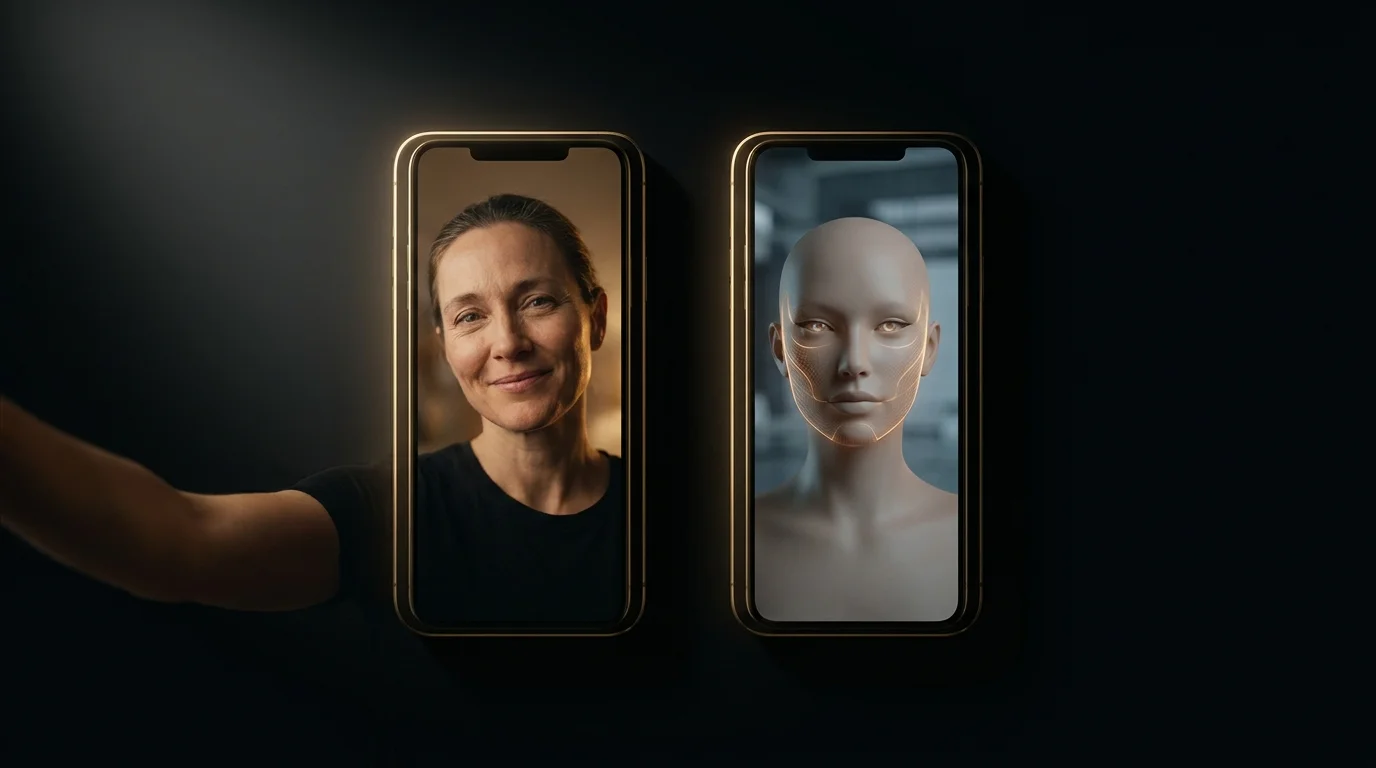
AI UGC is creator-style advertising made with a synthetic presenter rather than a person filming themselves. It can cost a few dollars in tool credits, while a real creator commonly charges $150 to $500 per video. The cheaper option fits some ad jobs better than others.
The short version: AI presenters can deliver hooks, product demonstrations, and explainers. Personal testimonials need a real experience behind them; the FTC rule effective October 2024 covers fabricated testimonials. Compare direction and review costs alongside tool credits, creator fees, and usage rights.
A presenter explaining a feature does a different job from a customer describing a result they achieved. This guide shows how that distinction affects production choices, costs, and how we combine AI and real creators in paid campaigns.
What does AI UGC actually cost compared to a real creator?
AI UGC costs a few dollars per asset in tool credits, compared with $150 to $500 per video from a real creator. Rights cost extra. Usage rights or a full buyout can push the creator price above $1,000.
AI UGC’s real cost is direction. Someone writes the script, picks the angle, generates a batch, and discards most outputs. According to inBeat’s 2026 UGC rate guide, most creator rates stay below $500 per video. Usage rights drive most of the difference.
| What you are buying | AI UGC | Real creator |
|---|---|---|
| Cost per asset | Low single-digit dollars in credits | $150 to $500, more with rights |
| Turnaround | Same day | 1 to 3 weeks including revisions |
| Usage rights | Owned outright | Negotiated, often time-boxed |
| Variant control | Change one line, regenerate | Re-shoot or re-brief |
| Can carry a testimonial | No | Yes, if the experience is real |
The last row changes the decision. You can weigh cost, speed, and rights against each other, but testimonial eligibility has a firm legal boundary.
Which one performs better in a paid ad?
Neither format wins by default because performance depends on the ad’s job. A synthetic presenter can match creator-shot footage for a hook or demo. Ads that rely on personal experience need more trust.
In the accounts we run, hooks, feature explainers, and product demos come back roughly even between AI and creator versions. The idea and first two seconds drive the scroll stop.
Ads built on lived experience behave differently. A person saying the product changed something for them carries proof that synthetic delivery cannot support. As viewers get better at spotting synthetic faces, the suspicion lands on the claim, not the pixels.
When does an AI creator stop being cheap and become a legal problem?
The moment it makes a claim about experience. The FTC’s final rule on consumer reviews and testimonials bans testimonials that misrepresent their source. That includes testimonials attributed to a nonexistent person or someone who never used the product.
According to the FTC’s final rule, it covers false reviews from nonexistent people, including AI fakes. People without real product experience are also covered. The rule took effect October 21, 2024, and allows civil penalties when its knowledge standard is met.
An AI avatar saying “I lost 20 pounds in six weeks” misrepresents who had the experience. If nobody achieved the result, the ad also invents the experience. A $3 production cost only makes the risky claim easier to scale.
The line is cleaner than most teams expect:
- Safe: an AI presenter explaining the product, showing the interface, or delivering a hook without a personal claim.
- Safe: an AI presenter reading a verified customer quote that is clearly attributed to that customer.
- Not safe: a synthetic face presenting a first-person result, transformation, or endorsement as their own.
That distinction drives how we split the work. AI UGC is a volume tool for hooks and demos. Proof-carrying ads stay creator work or real customer footage.
Not sure which of your ads are making claims?
Bring your current creative. We will sort each ad by its job. Then we will show which ads fit an AI workflow and which need a real person.
Book a Free Strategy CallWhich should you use for each ad job?
With that boundary clear, sort ads by their job. AI UGC fits hooks, explainers, and product demos because the script carries the result. Use a real creator when belief in the speaker drives conversion, especially for testimonials and lived-experience proof.
| The ad's job | Use | Why |
|---|---|---|
| Hook testing at volume | AI UGC | 20 hooks for the price of one shoot |
| Product demo or walkthrough | AI UGC | The interface is the proof, not the face |
| Feature explainer | AI UGC | Script carries it, cheap to iterate |
| Customer testimonial | Real customer | Legally required to be real |
| Lived-experience proof | Real creator | Belief is the conversion driver |
| Scaling a proven winner | Real creator | Worth the spend once the hook is validated |
Use a synthetic face when it is incidental and a real person when belief drives the ad. Never give a synthetic face a life it did not live.
What happens when the platform labels your ad as AI?
Assume the platform will label it. TikTok uses Content Credentials metadata to detect some AI-generated uploads, so disclosure is no longer fully in your control.
According to Adobe’s announcement, TikTok became the first social platform to support C2PA Content Credentials. It also began labeling AI-generated uploads that carry those credentials.
Plan for the label rather than around it. An AI label changes little for a demo ad because it never asked to pass as personal testimony. On a fake testimonial, the label exposes the problem.
How do we run both together?
In practice, we use AI to test early ideas and creators to develop proven hooks. Most ideas fail at that first stage. Keeping production cheap lets us test more options before paying for a creator shoot.
We start with 15 to 25 AI variants across distinct hooks. Everything else stays fixed until the reads are clean. Our creative testing framework for paid social covers the one-variable rule and the kill logic behind those decisions.
Then put real creator budget behind only the 2 or 3 surviving hooks. At that point, $400 funds a validated angle instead of a guess. That is when creator rates earn their price.
Who produces all of this is a separate question. Our AI creative agency vs creators vs in-house decision tree works through the three models and their total cost.
If you are weighing AI UGC against creator footage, we can help you sort the ads by the proof each one needs. Bring your current creative and the ideas you want to test. Book a Free Strategy Call to discuss where AI fits and where a real person’s experience matters.
Like this? Get the next one.
Short emails. New posts as they ship.