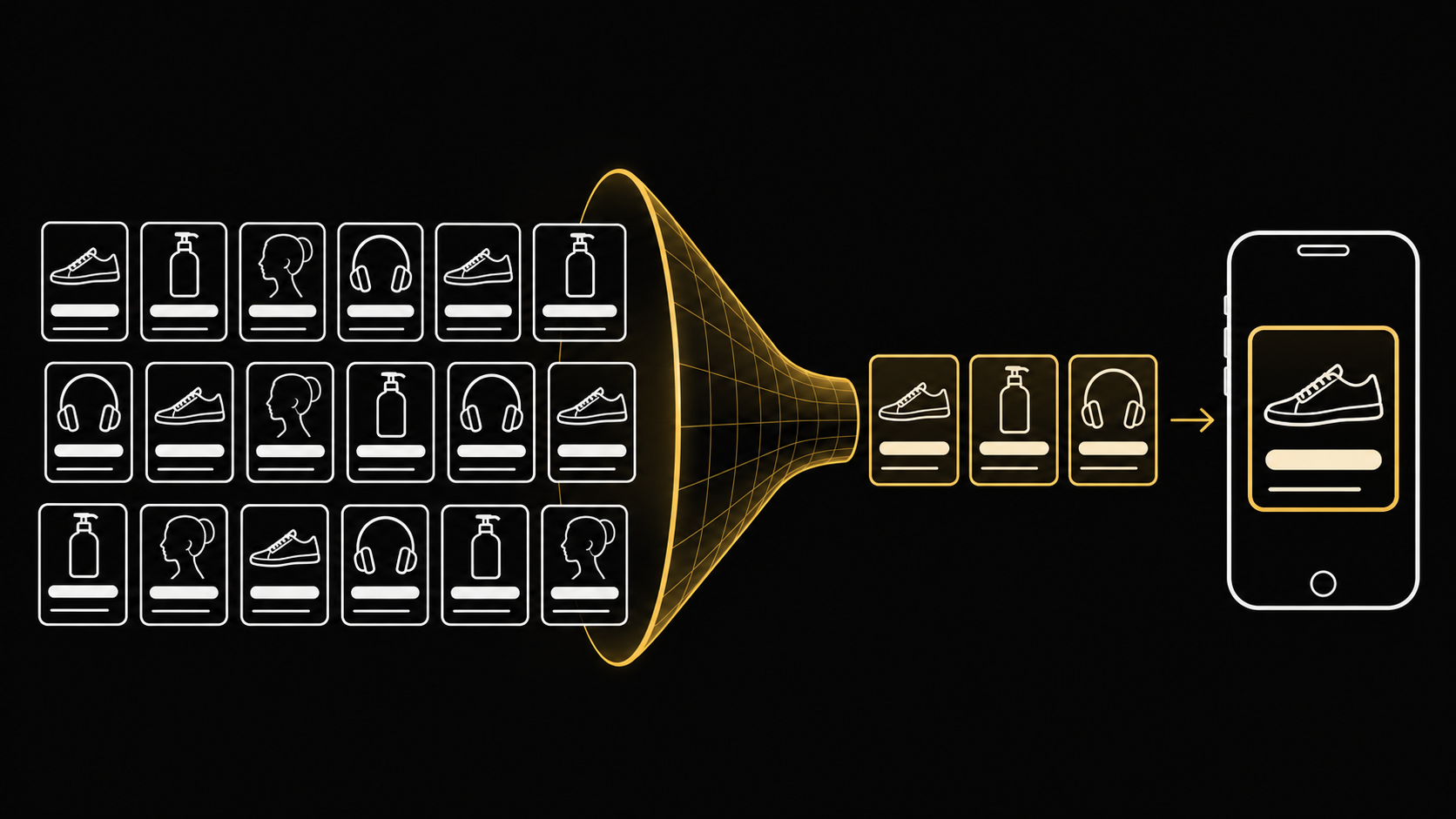
Your shared ad folder holds dozens of ads, and nobody on the team can say why each one was made. What is missing is a creative strategy: one page that tells the team what to make next and why. By the end of this article you can write that page for your own product.
Without it, the test budget still gets spent every month, and the team learns little it can use in the next brief. Below are the five questions that produce the page, a filled-in example, and what Meta, TikTok, Google and LinkedIn publish about how many different ads to run.
The short version: A creative strategy for paid ads is a one-page plan. It names the buyer, the beliefs you want to build, the proof, the formats, and the number that picks the next brief. The platforms publish different numbers for how many ads to run, so plan by concept and fund each one properly.
What is a creative strategy for paid ads?
A creative strategy for paid ads is the short plan that connects your business goal to what your ads say. It is written before any brief and changes far less often than the ads do. The creative brief turns one belief from that plan into an ad or a small batch of ads, and the test plan sets which ads run against each other.
Those three documents get confused, and they do different jobs. The strategy sets the boundary, the brief decides what one ad will say inside it, and the test tells you whether the belief landed. A team with briefs and tests and no strategy starts each round from a blank page.
| Document | What it decides | How often it changes |
|---|---|---|
| Creative strategy | The buyer, the beliefs, the proof, the formats and the deciding number | When results prove a belief right or wrong |
| Creative brief | The angle and opening line for one ad or a small batch | Each round |
| Test plan | Which ads run against each other, with what budget and for how long | Each round |
The other two documents have their own guides. Our guide to briefing an AI creative agency covers what goes into the brief, and our creative testing framework for paid social covers round sizes, budgets, and how long to wait before judging a result.
Why does a paid ads team need one now?
Meta now says its system groups ads that look alike and treats them as variations of one creative, and it asks advertisers for more variety. One large study of Meta accounts found that about one ad in twenty becomes a winner. A folder of near-identical ads gives the system little to test and your team little to learn.
In December 2025, Meta for Business said its system “analyzes creatives and groups together ads that share key visual and thematic attributes”. It adds: “When multiple ads look or feel alike, these are seen as variations of the same creative”. In its October 2026 post on how its ads system matches ads to people, Meta tells advertisers to “supply more creative variety so the system has more to test and learn from”. Our Meta Andromeda explainer covers what Meta has said about how it picks which ads to show.
The 2026 Creative Benchmarks from Motion (now Runneth) looked at 578,750 creatives, 6,015 advertiser accounts, and $1.29 billion in Meta ad spend. Its finding: “Roughly five percent of creatives on Meta spend at least 10× their account median.” The study calls those ads winners, and says an advertiser testing 4 ads per week “will surface roughly 0.2 winners per week on average.” This is a vendor’s study, it covers Meta only, and it defines a winner by how much an ad spent. It does not measure profit.
The arithmetic is still useful. At four new ads a week and about one winner in twenty, a team finds a winner roughly once every five weeks. Our reading of Meta’s guidance is that near-copies do little to improve those odds, because Meta sees them as variations of the same creative. The real decision is which different ideas get a turn, and a creative strategy is how you make it on purpose.
What goes on the one page?
The page answers five questions, each in a sentence or two: who the ad is for, what they should believe, what proof you have, what forms it will take, and which number decides. Keep the answers short. A question that needs three paragraphs is usually not settled yet.
- Who is this for, and what is happening in their day when they see it? Narrow enough that two people on your team would picture the same person.
- What should they believe afterwards that they did not believe before? Each belief written as one sentence. List only the ones you can fund a test for.
- What proof do we have? A product demonstration, a customer result, a number, a before and after.
- What forms will it take, and on which platform? Static image, video, carousel, creator-led, and where each one runs.
- Which number decides, and what does the next brief do with it? The number closest to revenue, an earlier signal if that number is slow, and the rule for what changes when a belief wins or loses.
Fitting it on one page forces the hard choices early. The brief and the test cannot settle a question the strategy left open.
What does a finished creative strategy look like?
A finished creative strategy is five short answers on one page: the buyer and their moment, the beliefs, the proof, the formats, and the deciding number. The page below is for a hypothetical subscription product, and every detail in it is illustrative.
Assume a meeting-notes app sold to software companies with 20 to 200 people. It costs $20 per user per month and offers a seven-day free trial.
| Question | Answer |
|---|---|
| Who, and in what moment | Operations leads at the end of a day full of meetings, with no notes from any of them |
| The beliefs | This app turns a meeting into a usable summary without anyone writing it down. A decision made in a meeting last month can still be found today |
| The proof | A short screen recording of a meeting becoming a summary, and one of a search finding an old decision |
| The forms | Vertical video on Meta and TikTok, single-image sponsored posts on LinkedIn |
| The deciding number | Cost per paid conversion, with cost per trial as the early signal |
The rule that goes with the last row: a belief that wins two rounds gets more proof and more formats, and a belief that loses two rounds gets rewritten.
That is the whole document. The page carries two beliefs, and each one is a separate concept to test.
The same thinking shows up in client work. Before our team made any ads for a podcasting software client, it mapped the audience in five target markets. The research produced the message angles: ease of use, audio quality, and remote collaboration. Each angle is a belief in the sense used above. Each got its own visual treatment, and every ad carried a specific guess about what would work in each market. The best new ads tripled their click rate. In one new market, cost per new customer fell from $34 to $2.59, a result that came from the paid media and creative work together.
If question two is the one you cannot answer yet, our competitor ad analysis guide shows how to turn what competitors are running into a belief worth testing.
How many different ads should you plan?
No single number applies everywhere. Meta, TikTok, Google and LinkedIn each publish their own guidance, the figures differ, and Meta’s December 2025 guidance gives no number. Our view is to plan by concept and run only as many concepts as your budget can fund well enough to give a clear result.
| Platform | What it publishes | Source |
|---|---|---|
| Meta | No number in its December 2025 guidance, which suggests "building a broad portfolio of assets" | Meta for Business, December 2025 |
| TikTok | 3 to 5 different creatives per ad group, and 3 to 5 diversified ad groups per campaign | TikTok creative best practices |
| Google Demand Gen | In each ad group, "at least 3 images or videos in each aspect ratio (vertical, square, and landscape)" | Google Ads Help |
| 4 to 5 ads in each campaign, replacing the one with the lowest engagement every 1 to 2 weeks | LinkedIn Sponsored Content tips |
Meta has published numbers before. In November 2024, Meta recommended “at least 20 diversified ads” for one campaign type, Advantage+ shopping, and “dedicating 20-30% of your overall ad budget towards testing new ads”. Read both as Meta’s figures for that campaign type at that time.
Variety has a limit too. Meta’s help page on ad volume warns: “When an advertiser runs too many ads at once, each ad delivers less often.” Its advice is to run fewer ads per ad set while keeping the creative in them diverse.
That is why we count concepts first and ads second. A concept is one belief from the strategy page, shown with its proof. A few concepts with enough budget behind each give clearer results than many thinly funded ones, and a test with no clear result has to be run again.
What changes for SaaS and subscription products?
In our experience, the main difference is that the sale happens after the click. Someone starts a trial, then pays days or weeks later. So the strategy has to name a deciding number beyond the click. Paid conversions also arrive slowly and in small numbers, so the page should carry a few concepts that differ clearly from each other.
Make the number closest to revenue the deciding number, and use a faster one as the early signal. Take the hypothetical meeting-notes app again. Suppose its cost per trial is clear within a week and its cost per paid conversion takes four weeks. Read cost per trial first, and wait for cost per paid conversion before a belief counts as proven. An ad that brings in plenty of trials and no paid conversions has not earned a place in the next brief.
For B2B products on LinkedIn, the platform’s help page on ad creative notes: “It’s common for the CTR of your ad to decline if you continue to display the same ad week after week.” So a B2B strategy has to plan for replacing ads as they wear out. In our experience, its deciding number sits further from the click, at qualified pipeline.
Who should own the creative strategy?
Our view: one person. They read the results each week and write the next brief, which means deciding whether a belief held up. In a small company that is usually the growth lead or the head of paid. Shared ownership leaves the next brief to whoever happens to be free.
On our team, a creative strategist studies the client’s buyers and past results and writes the brief. Our own AI software builds each ad, and a human editor finishes it. The client runs the ads in their own ad account, and the results come back to the strategist for the next brief. When a client also hires us for paid media, which is a separate service, the people running the account are in that loop too.
How do results change the strategy?
The strategy changes when a belief has been proven or disproven, which happens far less often than the ads change. Briefs change every round, and the ads change with them. Mixing up those rhythms is how teams end up rewriting the whole strategy after one bad week, or never updating it at all.
A belief that holds up earns more proof and more formats over the next few briefs. Our guide to iterating on winning ad creative covers what to do with a concept that has started to win. A belief that fails gets rewritten on the strategy page, and the next round tests the rewrite. When a winning concept starts to wear out, the creative fatigue guide shows how to spot it early, so fresh proof is ready before results slide.
Where should you start?
Start with what your competitors are already saying. It gives you a head start on question two, because you can see which beliefs your category already pushes and which ones nobody has claimed. The other four answers come from what you already know about your buyers and your product.
If you want help with that first step, our AI creative agency offers a Free Creative Competitor Analysis: we review the current paid creative from up to 3 of your competitors and map what they keep repeating. We bring that map and 3 creative tests we would run next for your brand to a free 30-minute working session, so you leave with the raw material for question two.